



Sign up for free!
Cybersecurity is not only a matter of technology.
It is a matter of preparation.
At the heart of the Galaxia hub in Transinne, IDELUX’s cyber range enables public and private organizations to test the resilience of their infrastructures in a secure and immersive environment. A realistic replica of IT/OT systems, credible attack scenarios, crisis management under real-life conditions: your teams train without any risk to your operational environments.
The introduction takes place through Module 1 (Introduction to cybersecurity) and Module 2 (Cybersecurity training). Regular access to the cyber range is granted after completing the “Training the Trainers” course, allowing participants to practically test their own processes.
Limited offer: access to the training courses is free until 30/09/2026!! Don’t wait!
Module 1: Introduction to cybersecurity
Duration : 2 hours | Prerequisite: None
Module presentation
In a time where cyberthreats are more and more present, sophisticated and targeted, this awareness session aims to give participants a clear understanding of the issues linked to cybersecurity. It provides training in the essential reflexes to adopt on a daily basis to effectively contribute to the protection of the organisation and comply with current regulations. A practical exercise in the cyber range reinforces learning through role play, based on an attack scenario.
Pedagogical objectives
Allow each participant to:
Programme
Module 2: Cybersecurity training
Duration : 6 hours | Prerequisite: MS Windows user

Module presentation
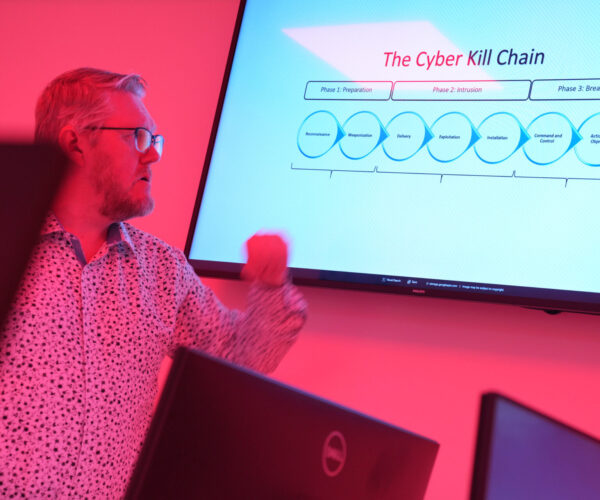
This training course offers a profound exploration of cyber concepts and threats for participants to better manage risks and reinforce their cyber resilience. Through theoretical contributions and two role play situations in the cyber range, this training course helps participants to better understand the mediums of an attack and the detection methods.
The course emphasises the role of each employee in upholding cybersecurity and offers practical advice to identify risks, adopt the best practices and respond efficiently to an incident.
Pedagogical objectives
Allow each participant to:
Programme
Module 3: Training the trainers
Duration : 2 days | Prerequisite: The participants must:
- have a personal work station for practical sessions ;
- be able to install software, including Visual Studio Code and MobaXterm on their device ;
- have a good command of Unix/Windows systems ;
- know how to debug logs and understand the basics of networks.
Module presentation
This training the trainers programme has been created to transfer the skills and knowledge required for the pedagogical use of the CITEF cyber range.
This training alternates between theory and role play to explore the architecture of the platform, its administration and the management of pedagogical contents. The participants will learn how to create, construct and deploy realistic cyber scenarios using tools such as Ansible and IaaS technologies. The training ends with a laboratory session where each participant will develop and execute their own scenario, ready to be used in future training sessions.
Pedagogical objectives
Train future trainers and scenario developers on the professional use of the CITEF IDELUX platform.
Programme

Module 4: Training for IT/OT professionals
Duration : 5 consecutive days | Prerequisite:This training is for professionals: System administrators, Network engineers, IT/OT engineers, OT developers and their managers. The participants must have the following competencies:
- Network notions: TCP/IP, DNS, DHCP, VLAN, basic routing, firewall, NAT.
- Culture logs & investigation: knowing how to read journals (system, network, application) and understanding the cycle of an incident (detection → response → recovery).
- Comfortable with IT tools:
- Command line (Windows PowerShell / Linux bash).
- Understanding of AD/LDAP environments (at least certain notions).
- Soft skills: able to work as part of a team, to document and follow procedures (runbooks).

Module presentation
This week of training, for IT and OT professionals, aims to improve awareness and operational preparation of teams against cyberattacks. It aims to train the participants to detect the threats, contain them, eradicate them and quickly reestablish activity after an incident.
Finally, it will help them to elaborate a practical communication and coordination guide to be used in the case of an incident, a real tool that will serve as a reference material for technicians to ensure efficient and structured management of cybersecurity incidents.
Pedagogical objectives
Number of participants: MAX 15 participants (5 managers + 10 technicians) – MIN 6 (2 managers + 4 technicians)
Programme
For the managers:
For the technicians: